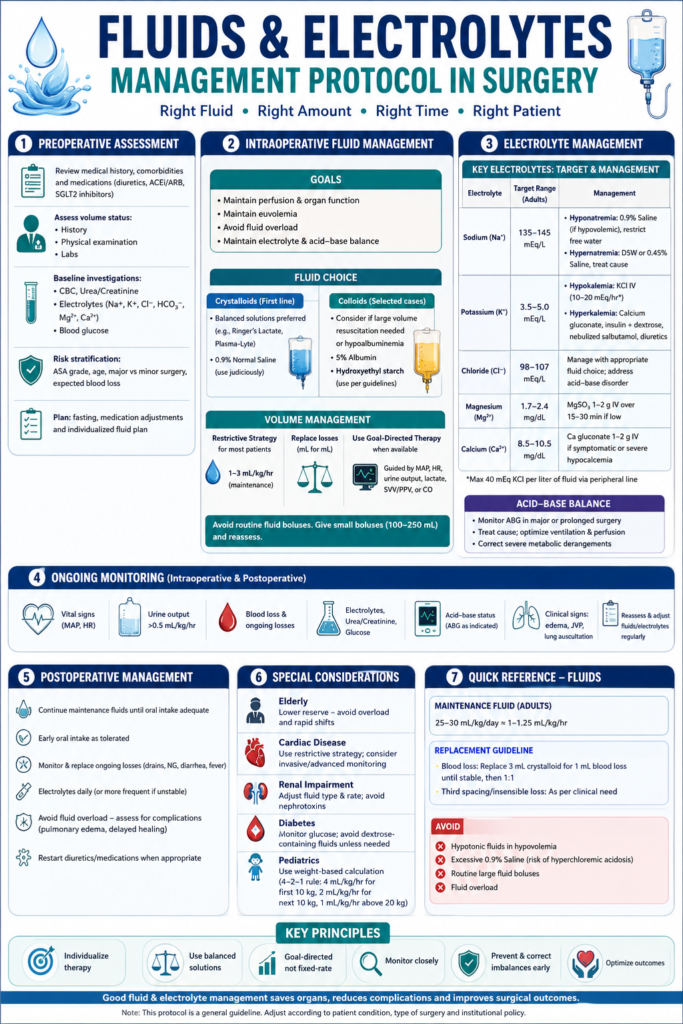
Internationally Accepted Protocol of Fluid and Electrolytes Management
In the realm of general surgery, meticulous perioperative management is a cornerstone of successful patient outcomes. Among the most critical, yet often underappreciated, components of this care is the strategic management of fluids and electrolytes. The physiological stress of surgery, anesthesia, and underlying pathology triggers a complex endocrine and metabolic response that can rapidly disrupt a patient’s homeostatic balance. An improper fluid and electrolyte strategy can lead to significant complications, including tissue edema, impaired wound healing, cardiac strain, and prolonged hospital stays. This article outlines an internationally accepted, evidence-based protocol for managing fluids and electrolytes in the general surgical patient, emphasizing a shift from rigid formulas to a nuanced, goal-directed approach.
The Physiological Backdrop: Surgery and Homeostasis
The surgical insult activates the hypothalamic-pituitary-adrenal (HPA) axis and the sympathetic nervous system, leading to the release of cortisol, catecholamines, and antidiuretic hormone (ADH). This “surgical stress response” results in:
- Sodium and Water Retention: ADH promotes free water retention, while aldosterone enhances sodium reabsorption in the kidneys.
- Potassium Shifts: Initial catecholamine-driven uptake of potassium into cells can be followed by later release due to tissue breakdown or acidosis.
- Third-Spacing: The systemic inflammatory response increases capillary permeability, causing fluid and protein to shift from the intravascular space into the interstitial compartment (the “third space”).
Understanding this physiology is paramount. The goal of management is not to completely abolish this natural response, but to support the patient through it while preventing its deleterious effects.
Preoperative Assessment and Optimization (The “Tune-Up”)
Effective management begins long before the first incision. A thorough preoperative assessment is crucial for identifying at-risk patients and correcting existing imbalances.
1. Diagnosis of Existing Imbalances:
- History: Assess for nausea, vomiting, diarrhea, reduced oral intake, diuretic use, and chronic conditions (e.g., heart failure, renal disease).
- Physical Examination:
- Volume Status: Assess skin turgor, mucous membranes, jugular venous pressure (JVP), and supine/standing blood pressure and heart rate.
- Signs of Hypovolemia: Tachycardia, hypotension, dry mucous membranes, decreased urine output.
- Signs of Hypervolemia: Elevated JVP, peripheral edema, pulmonary crackles.
- Diagnostic Criteria via Laboratory Studies:
- Serum Electrolytes: Identify hyponatremia, hypernatremia, hypokalemia, etc.
- Renal Function (Urea & Creatinine): Key indicators of renal perfusion and function.
- Acid-Base Status (Arterial/Venous Blood Gas): To diagnose metabolic acidosis/alkalosis.
- Complete Blood Count (CBC): Hemoconcentration may suggest volume depletion.
2. Preoperative Optimization (Correcting the “Base Deficit”):
The objective is to resuscitate the hypovolemic patient and correct significant electrolyte abnormalities before induction of anesthesia.
- Hypovolemia: Administer balanced crystalloid solutions (e.g., Lactated Ringer’s, Plasma-Lyte) in boluses of 500-1000 mL, reassessing after each bolus.
- Electrolyte Correction:
- Hypokalemia: Replace cautiously, typically not exceeding 10-20 mEq/hr via intravenous infusion, with close ECG monitoring.
- Hyponatremia: Correct slowly to avoid osmotic demyelination syndrome. The rate of correction should generally not exceed 6-8 mEq/L in the first 24 hours.
Intraoperative Management: The Goal-Directed Era
The intraoperative phase has moved away from the traditional “one-size-fits-all” high-volume fluid strategy to a more refined, goal-directed fluid therapy (GDFT).
1. Fluid Choices:
- Crystalloids: The mainstay of therapy. Balanced crystalloids (Lactated Ringer’s, Plasma-Lyte) are preferred over normal saline (0.9% NaCl) for maintenance and replacement, as they avoid the hyperchloremic metabolic acidosis associated with large-volume saline infusion.
- Colloids: (e.g., starches, albumin) are used more restrictively. International guidelines recommend against synthetic starches in critically ill and septic patients due to renal injury risks. Albumin may be considered in specific situations, such as large-volume paracentesis or liver disease, but crystalloids remain first-line.
- Blood Products: Used based on clinical evidence of anemia and coagulopathy, guided by point-of-care testing (e.g., thromboelastography) rather than empirical formulas.
2. Goal-Directed Fluid Therapy (GDFT):
This dynamic approach uses hemodynamic parameters to guide fluid administration, aiming to optimize stroke volume and cardiac output without causing fluid overload.
- Parameters Monitored: Stroke volume variation (SVV), pulse pressure variation (PPV), or changes in stroke volume in response to a passive leg raise or a fluid bolus.
- Protocol: A 250-500 mL bolus of a balanced crystalloid is given. If the stroke volume increases significantly (typically >10-15%), the patient is considered fluid-responsive and may benefit from further fluid. If not, further fluid is unlikely to help and may cause harm.
Postoperative Management: Mobilization and Monitoring
The postoperative phase focuses on facilitating a return to normal oral intake and mobilizing accumulated fluid.
- Early Enteral Nutrition: Promotes gut function and reduces bacterial translocation. As oral intake resumes, intravenous fluids should be tapered.
- Electrolyte Monitoring: Sodium, potassium, and magnesium levels should be checked regularly in the first 24-48 hours, as shifts are common.
- De-resuscitation: As the inflammatory response subsides, the body begins to reabsorb the third-spaced fluid and excrete it via the kidneys. Diuretics may be cautiously used in select patients with adequate renal function and evidence of fluid overload.
Ethical Values in Fluid Management
The administration of fluids, while seemingly a simple medical act, is imbued with ethical principles.
- Beneficence and Non-Maleficence (Do Good and Do No Harm): This is the core of the GDFT philosophy. The protocol is designed to provide the fluid necessary for organ perfusion (beneficence) while actively avoiding the harms of both under-resuscitation (e.g., acute kidney injury) and over-resuscitation (e.g., pulmonary edema, compartment syndrome).
- Patient Autonomy: The treatment plan, including the rationale for fluid choices and monitoring, should be clearly explained to the patient or their surrogate as part of the informed consent process for the surgical procedure.
- Justice: The protocol must be applied equitably to all patients, regardless of age, comorbidities, or background. This requires recognizing that a frail, elderly patient with heart failure requires a vastly different fluid strategy than a healthy young trauma patient.
The modern protocol for fluids and electrolytes management in general surgery is a dynamic and patient-specific strategy. It transcends simplistic volume calculations, advocating instead for a physiology-based, goal-directed approach across the entire peri-operative journey. By integrating thorough preoperative assessment, judicious intraoperative GDFT, and vigilant postoperative care, surgeons can significantly mitigate complications, enhance recovery, and uphold the highest ethical standards of patient care. This internationally accepted paradigm underscores that in fluid management, precision, not volume, is the true key to success.